.png)

At IPS Property Management, we believe in keeping you informed with data-driven insights to help you track the performance of your investments. As we close out the second quarter of 2026, we have analyzed the rental trends in the Belleville region to provide a clear picture of how the market is evolving.
Disclaimer on Rent Values (Property-Type Variability)
The Belleville rental market remained warm throughout Q2 2026, supported by steady tenant demand and limited rental inventory. As of July 1, 2026, the average asking rent across all property types was $2,150/month, representing a $150 (+7.5%) increase year-over-year and a $45 (-2.1%) decrease month-over-month.
Year-Over-Year Monthly Comparison (Q2 2026 vs. Q2 2025)
When comparing the start of this year to the same period in 2025, we see a significant shift in market momentum. While April started this year as higher than the previous year, as well May and June have shown robust growth. Average rent figures for all combined property types

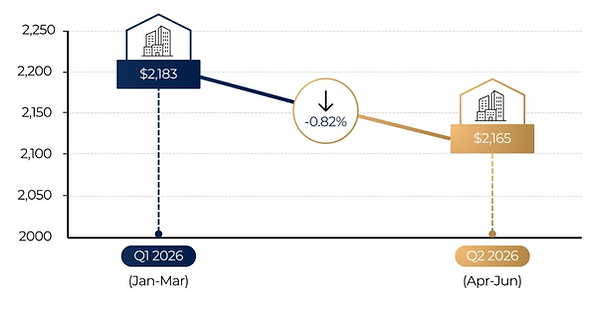
Quarterly Performance Comparison (Q2 2026 vs. Q1 2026)
Although Q2 recorded a slight seasonal decline compared to Q1, rental prices remained above 2025 levels, indicating continued market stability. Rental demand remained warm throughout Q2, and additional rental inventory has moderated rent growth, resulting in a more balanced market while maintaining healthy occupancy. At the same time, landlords continue to face higher operating expenses from property taxes, utilities, insurance, and maintenance, while tenants benefit from greater rental choice than in previous years.
Quarter-over-Quarter Comparison
Tracking Rental Trends from Q1 to Q2 2026
Legislative Update Tenancies Act (Effective July 1, 2026)
Another important development for Ontario landlords became effective on July 1, 2026, with new rules governing tenant-installed window and portable air conditioners. Where landlords do not provide air conditioning, tenants may now install their own window or portable air conditioning unit, provided certain conditions are met. Tenants must notify the landlord in writing before installation and, if electricity is included in the rent, provide any available energy efficiency information about the unit. They are also required to install and maintain the unit safely, comply with municipal property standards and all applicable laws, and ensure the installation does not cause damage to the rental unit or the residential complex.
These rights apply even if a lease agreement prohibits air conditioners, provided the tenant meets all legislative requirements. Tenants must also notify landlords of the intended period of use and when the unit is removed or no longer in operation. Landlords retain the right to inspect tenant-installed air conditioners by providing at least 24 hours' written notice to ensure the installation is safe, compliant, and not causing damage to the property.
Seasonal Rent Adjustments for Air Conditioners
For landlords who include electricity in rent, the new legislation permits a seasonal rent adjustment to recover the reasonable cost of operating a tenant-installed window or portable air conditioner. The seasonal charge applies only during the months the air conditioner is actually in use, and the increase cannot exceed the actual electricity cost or, where actual costs cannot reasonably be determined, a reasonable estimate based on the tenant's energy efficiency information and intended usage. Once the tenant removes the air conditioner or stops using it, rent must be reduced by the same amount. Notably, standard annual rent increase rules, including the 90-day notice requirement and the 12-month waiting period, do not apply to these seasonal adjustments. However, if the tenancy agreement specifically allows an air conditioner without an additional charge, no seasonal increase may be applied.
2027 Ontario Rent Increase Guideline
In addition to the July 2026 legislative changes, the Ontario Government has established the 2027 Rent Increase Guideline at 1.9% for most rent-controlled residential units. Landlords should note that the maximum annual guideline increase for 2027 is 1.9%, and that at least 90 days' written notice must be provided using the prescribed Landlord and Tenant Board form. Rent generally cannot be increased until at least 12 months have passed since the last lawful rent increase or the start of the tenancy. Additionally, certain residential units that are exempt from rent control may not be subject to the guideline.
Air Conditioner-Related Disputes
Where disputes arise regarding the new air conditioner rules, tenants have recourse through the Landlord and Tenant Board. Tenants who believe they have paid excessive seasonal charges, or whose rent was not reduced after removing an air conditioner, may apply to the Board using Form T1, while those who believe a landlord has improperly refused a qualifying air conditioner installation may apply using Form T2. Landlords, for their part, may pursue unpaid seasonal air conditioner charges through the normal rent arrears process.
Market Disclaimer
The rental values presented in this report are based on publicly advertised asking rents and available market data for Q2 2026. Actual rental values may vary depending on property type, bedroom count, location, square footage, age, condition, renovations, amenities, parking, utility inclusions, lease terms, and prevailing market conditions. This report is intended for general market information only and should not be considered a formal rental appraisal.
Rental Insights That Matter
Practical landlord and tenant tips, rental market updates, and key Ontario rule changes, clear, actionable insights delivered straight to your inbox to help you make smarter decisions.